


What Teens Eat Is Affecting Their Mental Health — And the Evidence Is Stronger Than Ever
A sweeping review of nearly 20 studies finds healthier diets are consistently linked to fewer depressive symptoms in adolescents. Here's what that means for your family.
When a teenager struggles with depression or anxiety, conversations tend to focus on therapy, medication, sleep, and social media. What tends to get far less attention is what is happening three times a day at the dinner table — or the drive-through window.
A March 2026 review published in the journal Nutrients and led by researchers at Swansea University synthesized findings from 19 studies examining the relationship between adolescent diet and mental health outcomes. The conclusion was striking in its consistency: healthier eating patterns are regularly associated with fewer depressive symptoms in teenagers, while poorer diet quality tracks closely with greater psychological distress.
This is not a fringe claim. It sits at the intersection of nutritional psychiatry, neuroscience, and gut-brain biology — three of the fastest-moving fields in mental health research. And its implications for families, clinicians, and adolescents themselves are significant.
Why Adolescence Is a Critical Window
Adolescence is not just a social transition — it is one of the most profound periods of biological transformation the brain undergoes in a lifetime. Between the ages of roughly 12 and 24, the brain undergoes extensive pruning and reorganization of neural circuits, massive changes in the prefrontal cortex (which governs planning, judgment, and emotional regulation), and a surge in hormonal activity that reshapes mood and stress reactivity.
These changes make the adolescent brain simultaneously more plastic — more capable of growth and learning — and more vulnerable to environmental factors, including what it is being fed. The Swansea researchers emphasize that this developmental window represents a crucial opportunity for prevention and early intervention, precisely because the neural and biological systems shaping long-term mental health are still actively forming.
Professor Hayley Young of Swansea University's School of Psychology: "Our findings suggest that public health and clinical strategies should prioritise whole-diet approaches over isolated supplementation when considering adolescent mental health."
The study also found that depression has received the most research attention, while other outcomes — including anxiety, stress, self-esteem, aggression, and externalizing behaviors — remain substantially understudied in relation to diet. This gap is itself significant, because for many adolescents, depression does not travel alone. It co-occurs with anxiety, ADHD-related difficulties, and sleep disorders.
Whole Diets Beat Supplements: The Key Finding
Among the review's most practically useful conclusions is the distinction between whole dietary patterns and individual nutrient supplementation. The six randomized controlled trials examined in the Swansea review found mixed results when it came to isolated nutrients. Vitamin D supplementation, for example, showed some benefit for reducing depressive symptoms in some studies — but the findings were inconsistent across populations.
The 13 prospective cohort studies told a clearer story. Diets that emphasized overall quality and balance — characterized by higher intake of vegetables, fruits, whole grains, legumes, fish, and minimally processed foods — were more consistently associated with better mental health outcomes than targeting any single nutrient alone.
This mirrors findings from the adult nutritional psychiatry literature. The landmark SMILES trial — a randomized controlled study published in BMC Medicine — showed that a Mediterranean-style diet intervention significantly reduced depression scores in adults with moderate to severe depression, with a number-needed-to-treat of just 4.1. The message: food works as a system, not as a series of individual chemical inputs.
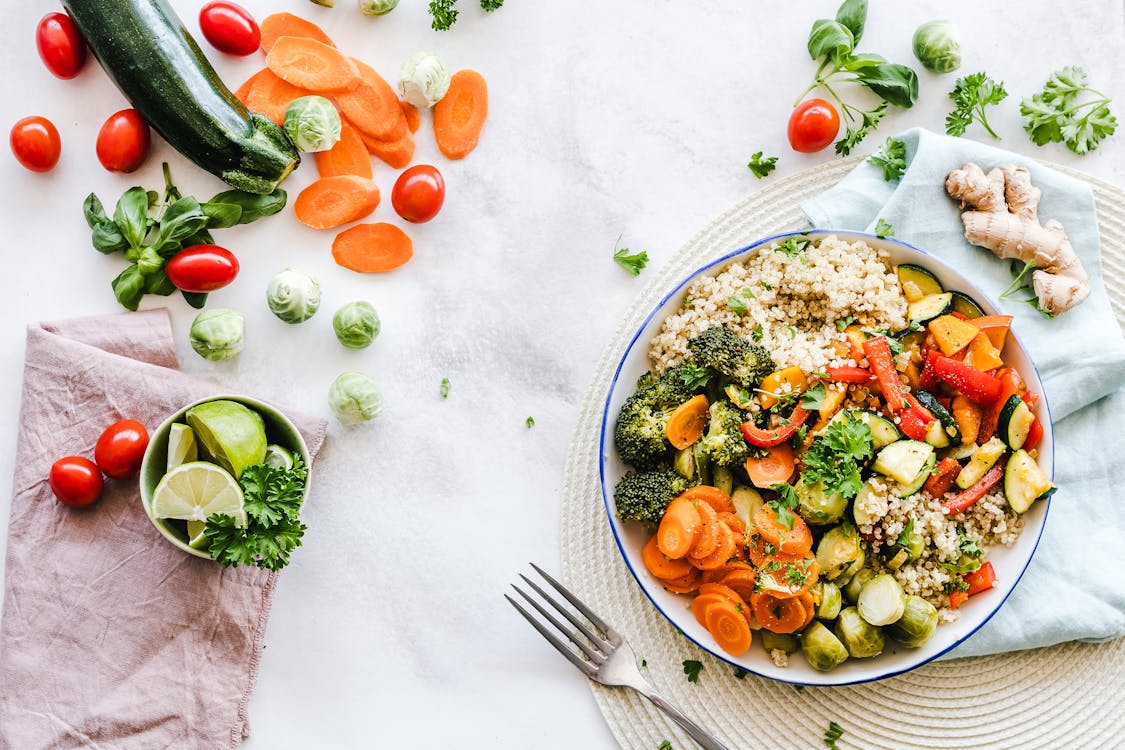
Research consistently shows that whole dietary patterns rich in vegetables, whole grains, legumes, and omega-3 fatty acids outperform isolated supplements in supporting mental health — especially during adolescence.
The Gut-Brain Connection: Why Food Affects Mood
Understanding why diet influences mental health requires understanding one of the most significant discoveries in neuroscience over the past two decades: the gut-brain axis (GBA). This bidirectional communication network links the gastrointestinal system and the central nervous system through neural, immune, and endocrine pathways — and it runs both ways.
A 2025 review published in Cureus describes the gut microbiome as a "pivotal player" in mental health through the gut-brain axis. Trillions of microorganisms living in the gut produce neurotransmitters, regulate inflammation, and signal the brain through the vagus nerve. Critically, what we eat determines which microorganisms thrive — and which don't.
A systematic review in Frontiers in Nutrition (2025) found that adolescent depression is associated with gut microbiome dysbiosis — an imbalance in microbial communities — and that disruption of gut-brain axis signaling may contribute to core behavioral symptoms including anhedonia (the inability to feel pleasure) and social withdrawal. Notably, the review found that adolescent depression affects 13% of youth globally, with 30–40% exhibiting treatment resistance — a convergence that makes diet-based and microbiome-targeted interventions an active area of clinical interest.
Key Biological Pathways
The mechanisms linking diet to teen mental health operate on several levels simultaneously:
- Neurotransmitter production: Roughly 90% of the body's serotonin is produced in the gut. Gut bacteria are involved in synthesizing serotonin, dopamine, and GABA — the neurotransmitters most directly implicated in mood, anxiety, and reward processing.
- Inflammation regulation: Poor diet triggers systemic low-grade inflammation, which has been repeatedly linked to depression. A 2024 umbrella review in BMJ across 32 meta-analyses found convincing evidence for a direct association between higher ultra-processed food consumption and anxiety symptoms.
- Blood-brain barrier integrity: The gut lining and the blood-brain barrier share structural vulnerabilities. Diets high in emulsifiers, additives, and low in fiber can increase intestinal permeability, allowing inflammatory signals to cross into the bloodstream and brain.
- Neuroplasticity and brain development: Omega-3 fatty acids, B vitamins, zinc, magnesium, and polyphenols all support the brain's capacity for neuroplasticity — the formation of new neural connections. Deficiencies during adolescence impair the very developmental processes that determine long-term emotional resilience.
The Ultra-Processed Food Problem
- Children and adolescents have the highest ultra-processed food (UPF) intake of any age group: 40–68% of daily calories in American teens come from UPFs.
- A meta-analysis of 17 observational studies covering 385,541 participants found that higher UPF consumption was associated with 1.53× higher odds of depression and anxiety symptoms combined.
- In adolescents specifically, high UPF intake correlates with boredom, crying, fear, worry, loneliness, and unhappiness in daily life.
- For every 10% increase in UPF intake as a proportion of daily calories, there is an 11% higher risk of depression.
- Ultra-processed foods now comprise 64.6% of total daily calories in American children's diets and 65.4% in U.K. children's diets — by far the highest rates globally.
- A 2025 Frontiers in Public Health review found UPF exposure during adolescence is linked to measurable disruption of brain development and fronto-limbic connectivity.
The Nutrients That Matter Most for Teen Mental Health
While the Swansea review confirms that whole dietary patterns matter more than individual nutrients, certain micronutrients play particularly well-documented roles in adolescent brain health. Pediatric clinicians at Contemporary Pediatrics identify the following as the most clinically relevant:
Omega-3 Fatty Acids
Essential for brain structure and function. Support cell membrane fluidity and are directly involved in dopamine and serotonin signaling. Found in fatty fish, walnuts, and flaxseed. Deficiency is associated with increased depression risk.
B Vitamins (esp. Folate, B12)
Required for neurotransmitter synthesis and methylation processes. B-vitamin deficiencies increase depression risk and folate deficiency may reduce antidepressant effectiveness. Found in leafy greens, eggs, legumes, and whole grains.
Magnesium
Involved in hundreds of enzymatic reactions, including those governing nerve transmission and mood regulation. Low magnesium is associated with anxiety, irritability, and insomnia. Found in leafy greens, almonds, pumpkin seeds, and avocados.
Vitamin D
Supports brain plasticity and mood regulation via the dopaminergic system. The Swansea review noted some evidence for benefit in adolescent depression, though findings were inconsistent. Primary source: sunlight; also found in fortified foods and fatty fish.
Zinc
Critical for neurodevelopment and immune function. Zinc deficiency has been linked to depression and anxiety across multiple studies. Found in meat, shellfish, legumes, seeds, and nuts.
Fermented & Fiber-Rich Foods
Feed beneficial gut bacteria, which produce neurotransmitter precursors and short-chain fatty acids that regulate the gut-brain axis. Found in yogurt, kefir, kimchi, whole grains, legumes, and vegetables.
"Before reaching for the prescription pad or referring to therapy, consider this: what she ate for lunch today might be part of the problem."
— Contemporary Pediatrics, on adolescent mental health and nutritionAn Important Caveat: Food Insecurity and Equity
Any discussion of teen diet and mental health must acknowledge that not all families have equal access to nutritious food. The Swansea researchers specifically flag that socioeconomic status is a significant moderating factor in the diet-mental health relationship — and that prescribing dietary change without addressing access barriers is insufficient.
In 2022, an estimated 19% of U.S. children — 13.4 million kids — lacked dependable access to adequate food, a figure that has risen nearly 50% since 2021. For food-insecure families, chronic stress around food access elevates cortisol levels and disrupts neurobiological development, independently increasing anxiety and depression risk. Dietary interventions must always be designed with equity in mind.

Regular family meals — where teens eat whole foods together with caregivers — are one of the most consistently supported protective factors for adolescent mental wellbeing, independent of individual dietary choices.
What Parents and Teens Can Do Right Now
The research is clear that improving dietary patterns is a worthwhile — and potentially significant — component of supporting teen mental health. The Swansea team emphasizes that diet is particularly valuable as an intervention because it is modifiable and scalable at a population level, unlike many clinical interventions that require specialist access.
Prioritize Whole Food Patterns
Focus on overall diet quality rather than any single "superfood" or supplement. A diet rich in vegetables, fruits, whole grains, legumes, and minimally processed proteins consistently outperforms targeted supplementation in research outcomes.
Reduce Ultra-Processed Foods
Swap convenience foods, fast food, packaged snacks, and sweetened drinks for whole-food alternatives wherever possible. Even partial substitution — not perfection — reduces inflammatory burden and gut disruption.
Eat Together When Possible
Family meals are independently associated with better teen mental health outcomes. They provide structure, social connection, and naturally tend toward less processed food than solo eating.
Support Gut Health
Fiber-rich foods and fermented foods (yogurt, kefir, kimchi) feed beneficial gut bacteria. Aim to introduce variety across the week rather than relying on any single probiotic supplement.
Address the Basics First
Make sure teens aren't skipping breakfast, are staying hydrated, and are eating at regular intervals. Blood sugar dysregulation — from erratic eating patterns — independently worsens mood instability and anxiety.
Treat Diet as Complementary Care
Diet is not a replacement for clinical treatment of depression or anxiety. It is a meaningful complement to therapy and medication. If your teen is struggling, professional evaluation is essential — dietary change supports but cannot substitute for clinical care.
What the Science Still Needs to Resolve
The Swansea review is careful about its limitations. Most of the evidence linking diet to adolescent mental health comes from observational studies — which can identify associations but cannot definitively prove causation. Does poor diet cause depression, or do depressed teens make worse food choices? The answer is almost certainly both, operating in a reinforcing cycle — but disentangling the directions of causality requires higher-quality prospective and experimental research.
The review identifies several key gaps that future studies must address:
- Expanding outcomes beyond depression to include anxiety, stress, self-esteem, and behavioral problems
- Including biological markers — gut microbiome profiles, inflammatory markers, nutrient levels — to clarify mechanisms
- Better standardization of dietary assessment methods across studies to allow meaningful comparisons
- Broader demographic representation, including across socioeconomic backgrounds and sex differences
- Open science practices to improve reproducibility of findings
Despite these limitations, the direction of evidence is consistent enough that the American Psychiatric Association and the Royal Australian and New Zealand College of Psychiatrists already recommend lifestyle changes — including diet — as components of depression management. The science is pointing in one direction, even if the fine-grained details remain in progress.
Your Teen Deserves a Comprehensive Evaluation
Diet matters — but when a teenager is struggling, so does professional support. Our board-certified psychiatrists evaluate adolescents and young adults via secure, private telehealth from anywhere on the East Coast.
Book an EvaluationMost major insurance plans accepted | Same-week appointments available
Sources & Further Reading
- Tucker J, Brennan A, Benton D, Young H. A Recipe for Resilience: A Systematic Review of Diet and Adolescent Mental Health. Nutrients. 2025;17(23):3677. doi.org/10.3390/nu17233677
- Swansea University. What teens eat could be affecting their mental health more than we thought. ScienceDaily. March 29, 2026. sciencedaily.com
- Liu et al. Gut-brain axis in adolescent depression: a systematic review. Front. Nutr. 2025. pmc.ncbi.nlm.nih.gov
- Patil S, Mehdi SS. The Gut-Brain Axis and Mental Health. Cureus. 2025;17(7):e88420. pmc.ncbi.nlm.nih.gov
- Lane MM, et al. Ultra-processed food consumption and mental health: systematic review and meta-analysis. Nutrients. 2022;14(13):2568. pmc.ncbi.nlm.nih.gov
- Lane MM, et al. Ultra-processed food exposure and adverse health outcomes: umbrella review. BMJ. 2024;384:e077310. pubmed.ncbi.nlm.nih.gov
- Brain food: Nutrition's critical role in teen mental health. Contemporary Pediatrics. 2025. contemporarypediatrics.com
- Merlo G, et al. Gut microbiota, nutrition, and mental health. Front. Nutr. 2024;11:1337889. frontiersin.org
- Consequences of ultra-processed foods on brain development. Front. Public Health. 2025. frontiersin.org